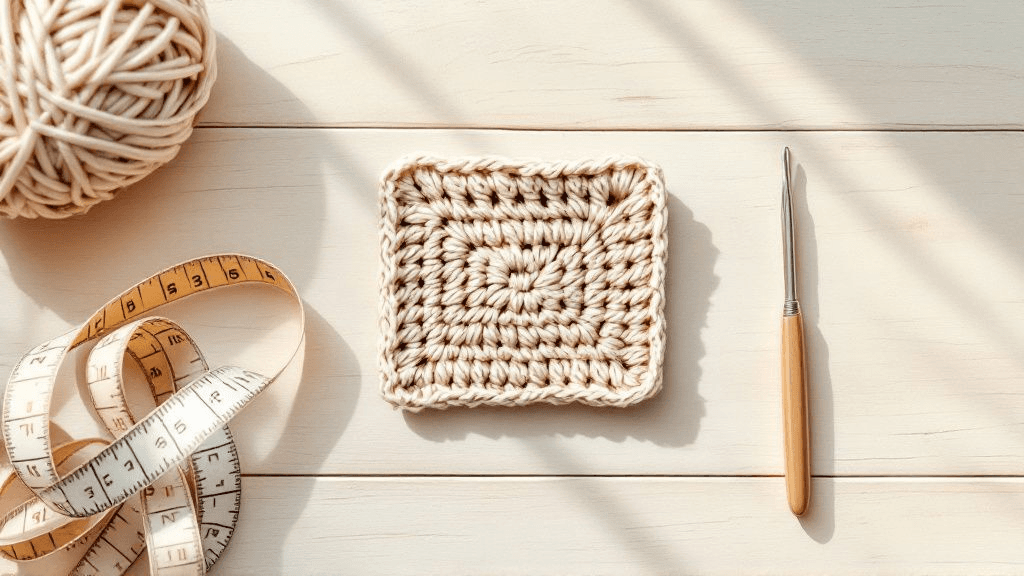
Gauge for amigurumi matters less than for clothing, because a toy does not have to fit anyone. What matters is that your fabric is dense enough to hide the stuffing, and that your size is close to the pattern's if you want the same result. Measure stitches per inch on a swatch or the first rounds, then change hook size to move closer.
What gauge actually measures
Gauge, called tension in UK patterns, is the number of stitches and rows (or rounds) that fit in a set width, usually 4 inches or 10 cm. It depends on three things working together: the yarn, the hook, and your hands.
For a sweater, a small difference in gauge multiplies across every stitch of the garment and the garment no longer fits. An amigurumi is small and stuffed, so being a few stitches off per 4 inches changes the size, not whether the toy works. That is why many toy patterns do not give a gauge at all, or give it only as a guide.
Two different goals: size and density
Amigurumi gauge has two jobs, and it helps to keep them apart.
Density. Amigurumi fabric should be tighter than for a blanket or scarf. If you can see clear gaps between stitches when the piece is stretched slightly, stuffing will show through. This is why amigurumi patterns often recommend a hook smaller than the one printed on the yarn label.
Size. If you want your toy to match the pattern's finished height, or if parts from two different patterns must fit together, then stitches per inch matter more.
| Yarn weight category | Typical label hook range | Hook often used for amigurumi | What changes |
|---|---|---|---|
| 1 Super Fine | 2.25-3.5 mm | toward the small end of the range or smaller | Very small, detailed toys |
| 2 Fine | 3.5-4.5 mm | around 2.5-3 mm | Small to medium toys |
| 3 Light (DK) | 4.5-5.5 mm | around 3-3.5 mm | Common amigurumi size |
| 4 Medium (worsted) | 5.5-6.5 mm | around 3.5-4 mm | Larger, softer toys |
| 5-6 Bulky / Super Bulky | 6.5-15 mm | follow the pattern | Large plush toys |
The label ranges come from the Craft Yarn Council's yarn weight system and are guidelines. The amigurumi column is a common starting point, not a rule; the pattern's own recommendation always comes first.
How to measure gauge for a toy pattern
There are two practical ways.
Option 1: a flat swatch
- Chain about 20 stitches with the yarn and hook you plan to use.
- Work single crochet in rows until the piece is roughly square.
- Lay it flat without stretching.
- Count the stitches across 2 inches in the middle of the swatch and double it, or count across 4 inches if the swatch is large enough.
- Count rows the same way, vertically.
Option 2: the first rounds of the actual piece
For amigurumi, many crocheters skip the flat swatch and check the first piece instead. Work the head, or the first eight or nine rounds of it, then measure the diameter of the flat circle or the height of the piece. Some patterns give a measurement for exactly this, for example "the head should be about 3 inches across after round 9".
Rounds worked in a spiral behave a little differently from flat rows, so the second option is often more accurate for toys.
Too big, too small: what to change
| What you see | Meaning | What to try |
|---|---|---|
| Fewer stitches per inch than the pattern | Your stitches are larger | Use a smaller hook, about 0.25-0.5 mm at a time |
| More stitches per inch than the pattern | Your stitches are smaller | Use a larger hook, as long as no gaps open up |
| Right count but visible gaps | Fabric too loose for stuffing | Smaller hook, or yarn under technique |
| Fabric stiff and hard to work | Too tight | Larger hook, or relax how you hold the yarn |
Change the hook rather than trying to force your hands to crochet differently. Most people have a natural tension that is hard to alter consistently over a long project. If you want to work on tension itself, our article on crochet tension and how to hold the yarn covers the hand side of it.
Why your toy comes out bigger than the photo
This is one of the most common questions, and gauge is only part of the answer.
- Yarn substitution. Two yarns in the same weight category can differ in thickness. A "light" cotton and a "light" acrylic may give noticeably different sizes.
- Hook size. A 0.5 mm difference changes the size of every stitch, and that adds up over 30 rounds.
- Stuffing. Firmly stuffed pieces stretch and grow a little. Lightly stuffed pieces stay smaller.
- Your technique. Yarn over versus yarn under changes both the height and the look of single crochet.
- Measuring point. Some patterns measure sitting height, others standing height including ears.
If your toy must match another piece exactly, for example a set of clothes made for a specific doll, check gauge on the first piece and adjust before you go on.
Changing size on purpose
Gauge is also the tool you use when you want a toy bigger or smaller than the pattern. Thicker yarn with a larger hook scales everything up, and finer yarn with a smaller hook scales it down, while the stitch counts stay the same. Our guide to resizing an amigurumi pattern explains how to estimate the new finished size before you start.
A note on materials lists
When a pattern names a yarn weight and hook size, treat that pair as the reference for its stated finished size. If you want the same size, stay with the same weight category, then match the hook to your own tension. If you are happy with a different size, any combination that gives a dense fabric will work.
Summary
For amigurumi, aim for fabric dense enough that stuffing does not show, then use gauge to get close to the size you want. Measure on a swatch or on the first rounds, adjust the hook by small steps, and write down what you used so your next toy from the same yarn starts in the right place.
Before you start a new design from our amigurumi patterns in PDF, or any other pattern, note the yarn weight and hook it names and make that your first test.