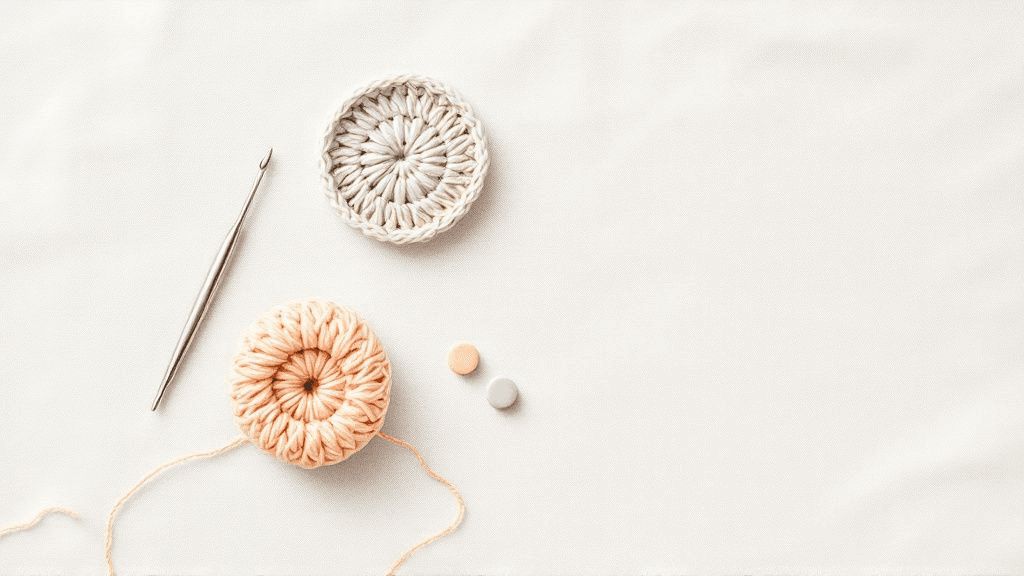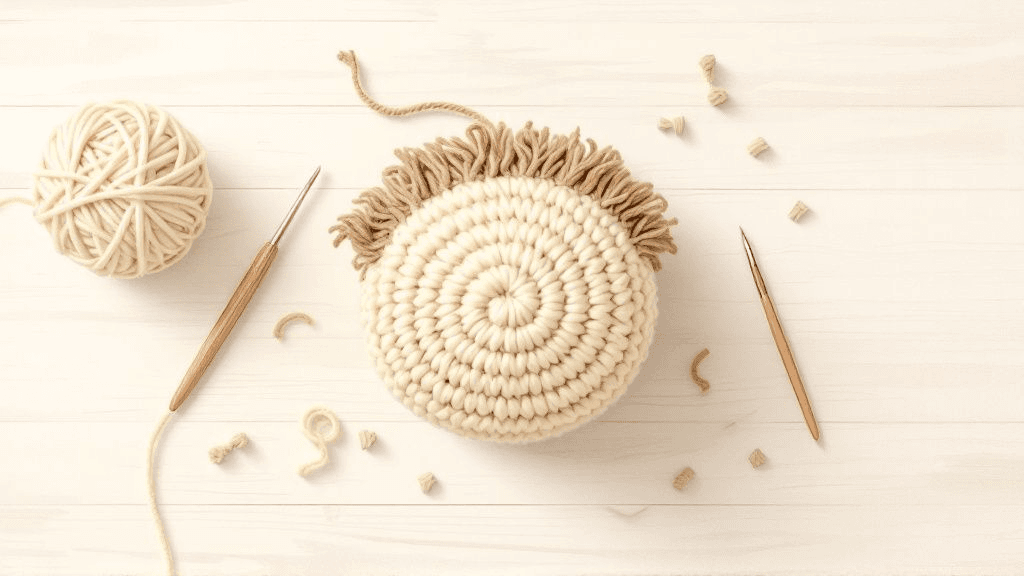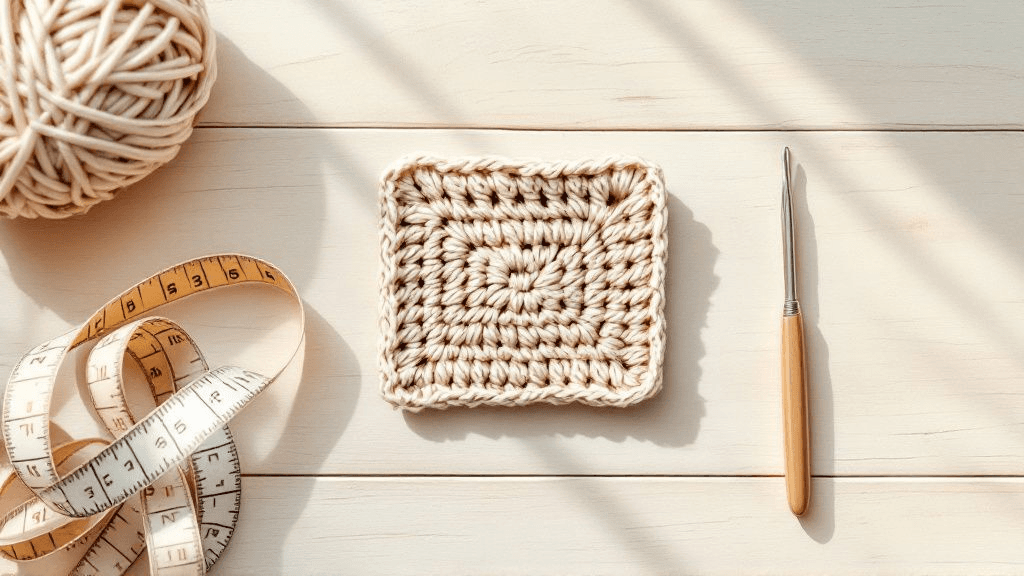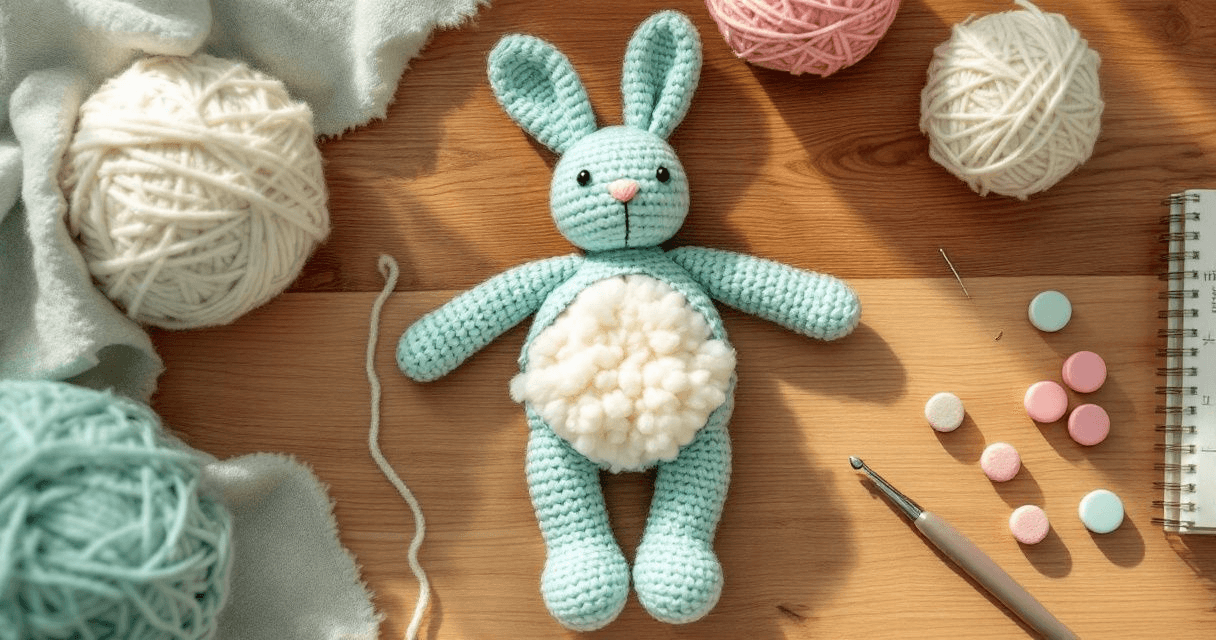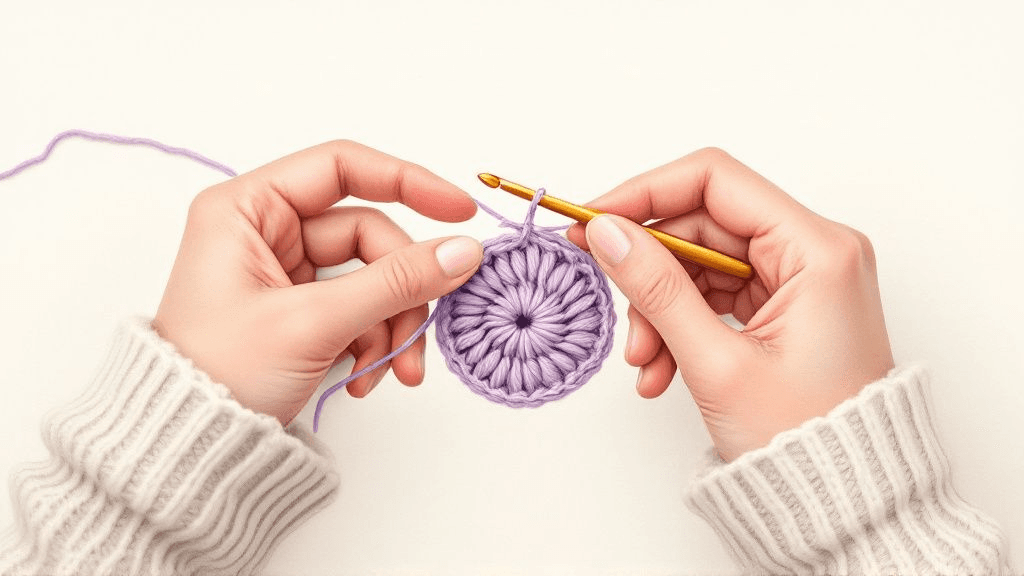
Crochet tension is how firmly the yarn feeds into your stitches, and how you hold the yarn controls it. Wrap the working yarn around the fingers of your non-hook hand so it slides with light, steady drag, and size each loop on the shaft of the hook rather than the tip. Even tension gives even stitches, which matters most in amigurumi.
What tension really means
Tension is not how hard you pull. It is how consistently the yarn flows from the ball to the hook, and how big each loop is when you complete a stitch. Two crocheters with the same yarn and hook can produce fabrics of very different sizes because their tension differs. That is normal, and it is why patterns give a hook size as a starting point rather than a rule.
For amigurumi, the goal is a dense, even fabric where stuffing does not show between stitches. That comes from consistency more than from tightness. A crocheter who works every stitch at the same moderate tension usually gets neater toys than one who pulls hard on some stitches and relaxes on others.
Three common ways to hold the yarn
There is no single correct hold. Try each for a few rounds and keep the one that feels natural and gives you even loops.
| Hold | How it works | Suits |
|---|---|---|
| Over the index finger | Yarn runs between the little and ring fingers or around the little finger, then over the raised index finger | Most beginners; gives a clear view of the yarn |
| Wrapped around the index finger | Yarn wraps once fully around the index finger for extra drag | Slippery yarns, loose crocheters |
| Pinky wrap | Yarn wraps once around the little finger, then over the index finger | Crocheters who need more control and even feed |
In all three, the thumb and middle finger of the yarn hand hold the work just below the hook. Holding the work close to where you are stitching keeps it from twisting and makes every stitch the same size.
The hook hand can use a pencil grip, held like a pen, or a knife grip, held from above. Neither is better; pick the one that lets you keep your wrist relaxed.
Sizing loops on the shaft
Most crochet hooks have a throat, where the hook catches the yarn, and a shaft below it, which is the part with the stated millimeter size. Loop size is set by the shaft.
When you pull up a loop, let it settle onto the shaft before you yarn over again. If you work each loop on the narrow throat, the stitches end up tighter than your hook size and uneven, because some loops reach the shaft and some do not. If you drag every loop far down onto the handle, they come out too big.
Watching where your loops sit for a few rounds is one of the most useful exercises for a new crocheter.
Signs your tension is too tight
- It is hard to push the hook into stitches from the previous round.
- Your hand or wrist aches after a short session.
- The fabric is stiff and curls, and pieces come out smaller than the pattern states.
Fixes: loosen your grip on the hook, let the yarn slide more freely by removing a wrap, make sure loops reach the shaft, or go up half a hook size.
Signs your tension is too loose
- You can see stuffing between stitches.
- Stitches look large and open, and pieces come out bigger than expected.
- The yarn feels like it falls off the hook.
Fixes: add a wrap around a finger for more drag, keep the work held closer to the hook, or go down a hook size. Our guide to fixing gaps in amigurumi has more remedies for see-through fabric.
Signs your tension is uneven
Uneven tension shows up as rows of stitches that look different from one another, often because you put the work down and picked it up later, or because the yarn snagged and you pulled through.
Fixes:
- Pull a length of yarn loose from the ball before each round so the feed is not fighting the ball.
- Keep the ball in a bowl or bag so it does not roll and jerk the yarn.
- Pause at the end of a round rather than in the middle of a stitch.
- Warm up with a round or two on a practice piece if you have been away from your project.
Tension and gauge
Tension is the habit; gauge is the measurement that results from it. If your gauge does not match a pattern, change the hook size rather than trying to force a different tension. A tension that feels natural is the one you can repeat across a whole project. We explain how to measure it in our guide to gauge for amigurumi.
Yarn matters too
Some yarns are much harder to tension evenly than others.
- Smooth cotton shows every uneven stitch but gives crisp definition once your tension settles.
- Acrylic is forgiving and slides at a steady rate.
- Plush or chenille-style yarns stretch as you pull, which can make loops creep larger; hold them with less drag and count carefully.
- Splitty yarns catch on the hook; a hook with a rounder head can help.
Practicing tension
A short practice routine helps more than any single trick. Chain 15, work rows of single crochet for a few minutes, and look at the edges. Straight edges and same-sized stitches mean your tension is steady. Then crochet a flat circle of six rounds and see whether it lies flat. Repeat with your chosen hold until both pieces look even.
It also helps to compare pieces made on different days. Label each practice swatch with the hold and hook you used, and keep them together. After a week you will see which combination gives you the most consistent stitches, and that becomes your default for new projects.
Comfort counts as much as neatness. Take breaks, stretch your hands and change position. Tension often drifts when you are tired, so stopping at the end of a round is usually wiser than pushing through.
When your stitches feel steady, a small project is a good next step; browse our amigurumi PDF patterns and pick a design with few parts so you can watch your tension round after round.