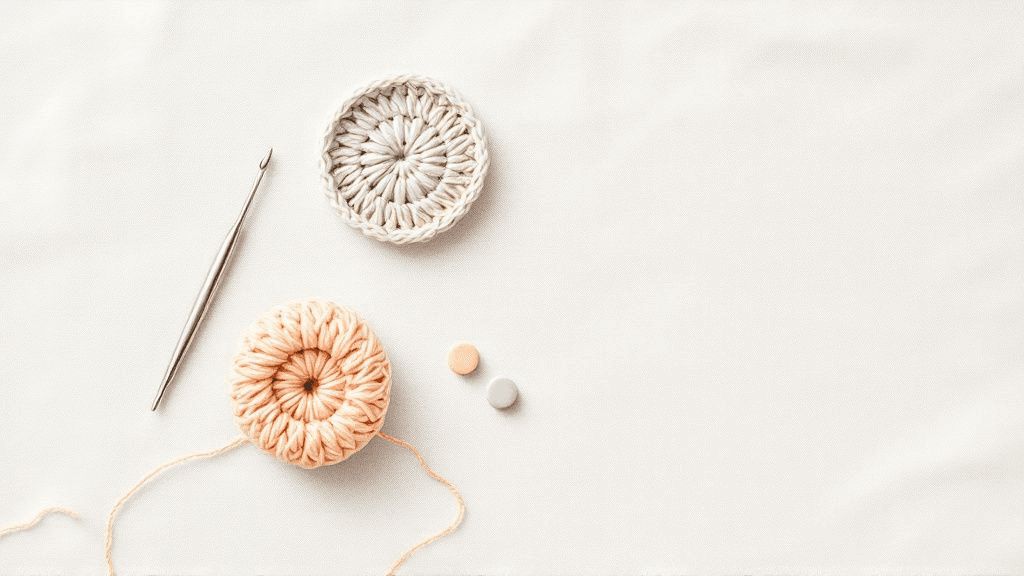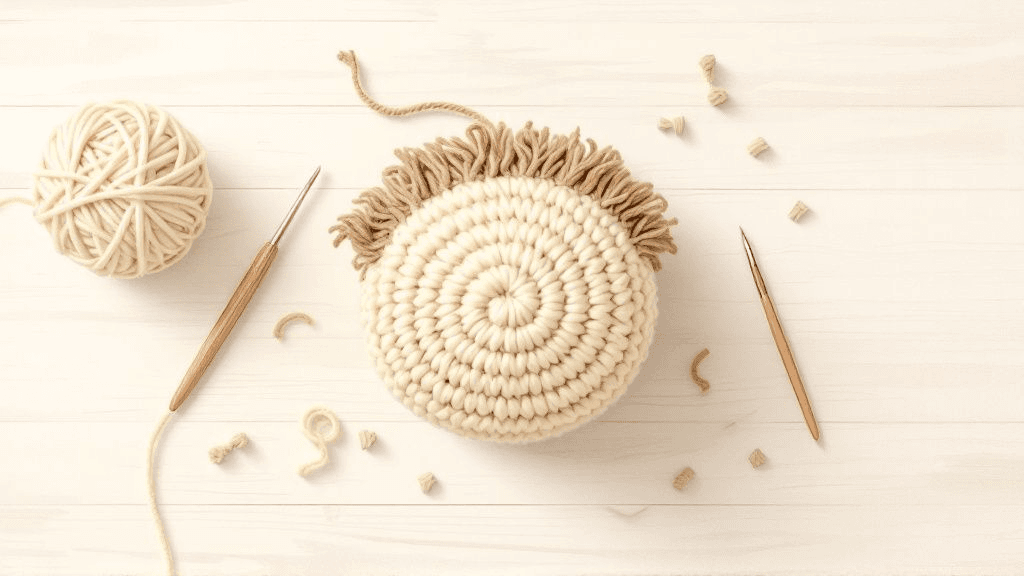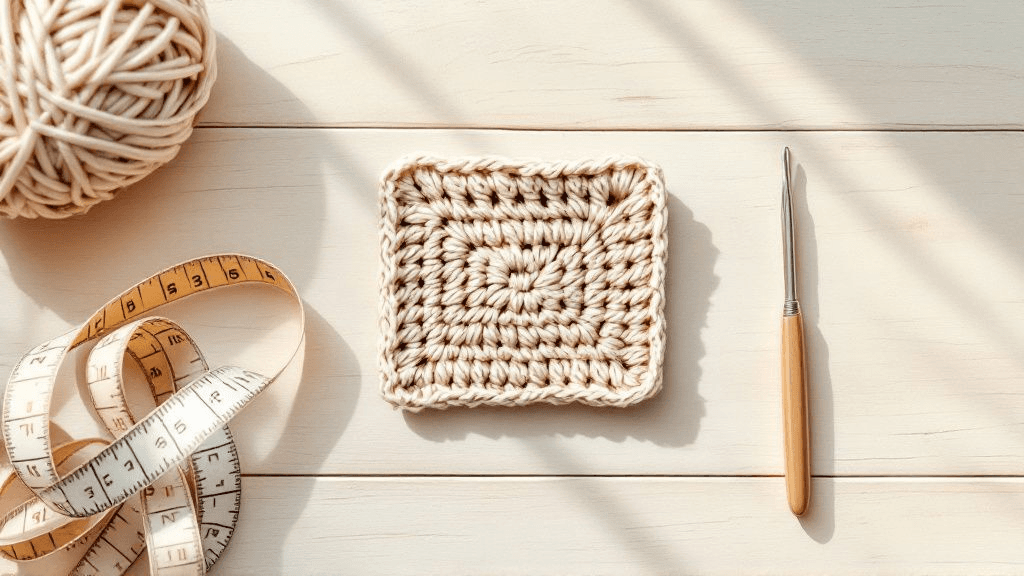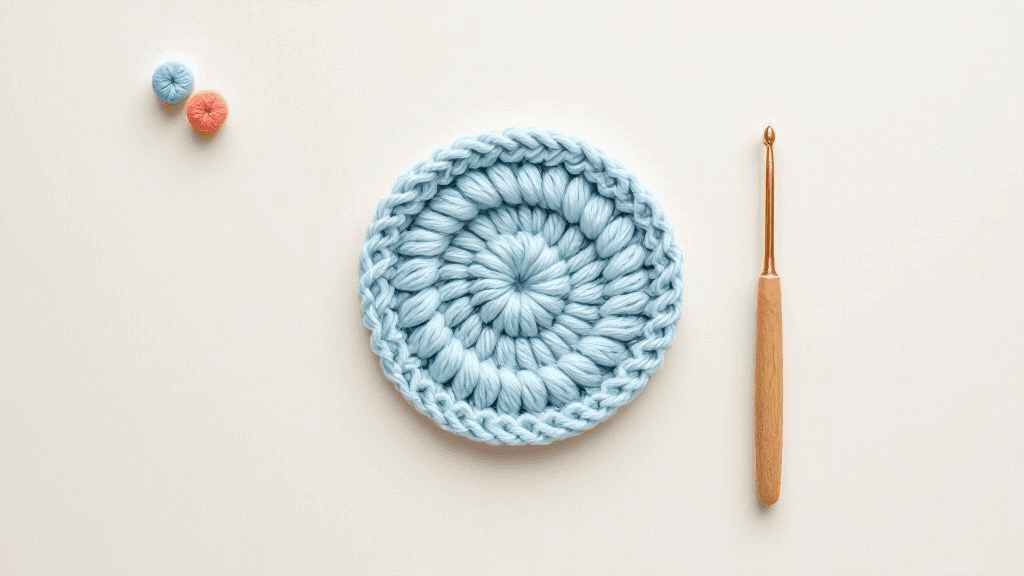
Back loop only crochet (BLO) means inserting your hook under just the back loop of each stitch instead of both loops. In amigurumi, a BLO round leaves the unused front loops as a ridge on the outside, which turns a flat base sharply into straight walls. Front loop only (FLO) does the opposite and leaves a ridge of back loops.
The two loops on top of every stitch
Look down at the top edge of your crochet and you will see a row of sideways Vs. Each V is the top of one stitch, and each has two strands:
- The front loop is the strand closest to you.
- The back loop is the strand farthest from you.
Normally you insert the hook under both strands of the V. When a pattern says BLO or FLO, you go under just one of them. The other strand stays unused and sits on the surface of the fabric as a little line.
In amigurumi, "closest to you" assumes you are looking at the outside of the piece with the hole of the round facing you as you work. If your piece is inside out, front and back are swapped, so check that the right side is facing out before you start loop-only rounds.
What BLO does to a piece
When you work a round in back loops only, the front loops of the previous round stay unused on the outside. That unused line acts like a fold, so the fabric bends at that point.
This is why BLO is everywhere in amigurumi:
| Use | What happens | Example |
|---|---|---|
| Flat base to straight wall | Fabric turns at a sharp angle | Feet, shoes, pots, flat-bottomed bodies |
| Clean fold line | Piece bends neatly at the ridge | Hat brims, box shapes |
| Attachment line | Unused front loops act as a seam guide | Sewing on a skirt or collar |
| Texture | Rows of ridges | Ribbed or striped surfaces |
A typical example: crochet a flat oval for the sole of a foot, then work one round in BLO. The edge turns up and the rest of the foot grows straight up from a crisp base. Our guide to making amigurumi stand up uses this trick for stable feet and bodies.
What FLO does
Working a round in front loops only leaves the back loops unused. On a round piece, those back loops sit on the inside or form a line on the surface, depending on how the piece is shaped. Designers usually use FLO for:
- Ruffles and frills: work FLO and increase heavily, so a ruffle stands out from the surface.
- Leaving a ridge for later: the unused back loops become a place to crochet a second layer, such as a skirt, collar or cap brim.
- Cuffs and folds: a sleeve or boot cuff can be folded at an FLO line.
When a pattern says "in the unused loops of round 12", it means go back to the loops you skipped and work into them, usually with a new strand of yarn.
How to work a BLO round
- Find the first stitch of the round, where your marker sits.
- Insert the hook under the back loop only, from front to back.
- Work the stitch as normal, for example a single crochet.
- Continue around, always picking up only the back loop.
- Count the round; BLO does not change the number of stitches.
The stitch is the same; only the place where the hook goes in changes. Patterns write it as "BLO sc in each st (24)" or "Rnd 7 (BLO): sc around (24)".
BLO in flat rows
Loop-only stitches also appear in pieces worked flat in rows, such as scarves and clothes for toys. Working every row in the back loop only creates a stretchy ribbed fabric with ridges running across, which is a common choice for cuffs and waistbands. Because you turn at the end of each row, the ridges alternate sides and lie neatly in pairs. When a pattern for doll clothes says "sc in BLO across" for many rows, this ribbing is the goal, and the piece will stretch sideways much more than plain single crochet.
Common mistakes
- Working the wrong loop. If your ridge appears on the inside instead of the outside, you probably worked FLO instead of BLO, or the piece was inside out. Undo the round and check which side faces you.
- Forgetting to go back to both loops. BLO usually applies to one round only. The next round goes back to both loops unless the pattern says otherwise.
- Stretching the loop. A loop-only stitch can look looser. Keep your tension even so the ridge stays neat.
- Losing the start. The ridge can make the marker harder to see. Place it clearly in the first stitch.
Loop-only rounds and abbreviations
The abbreviations are BLO or BL for back loop only, and FLO or FL for front loop only. Some patterns add "only" in full; others put the loop instruction in brackets at the start of the round. Our crochet abbreviations list covers these together with the other short forms you will meet.
The third loop
On half double crochet there is also a third loop: a horizontal bar on the back of the stitch, below the top V. Working into it creates a raised line on the front, which some patterns use for knit-like texture on clothes. It is less common in toys, but if a pattern mentions the "third loop" or "back bar", that is what it means.
Practicing BLO and FLO
Try a small cup: 6 sc in a magic ring, then increase rounds to 24 stitches. Work one round in BLO and watch the edge turn up. Crochet four plain rounds for the wall. Then work one round in FLO with an increase in every stitch and see a frill form. In under half an hour you will have seen both techniques and the ridges they leave.
Using the leftover loops to attach parts
One of the neatest uses of loop-only rounds is planning a place to attach something. If a toy has a skirt, the designer may tell you to work one round of the body in FLO. Later, you join new yarn into the unused back loops and crochet the skirt directly onto the body, with no sewing. The same idea works for collars, hat brims and leaf crowns.
Look for BLO and FLO rounds in the instructions of our amigurumi pattern PDFs and you will see how much shaping comes from a single change of loop.