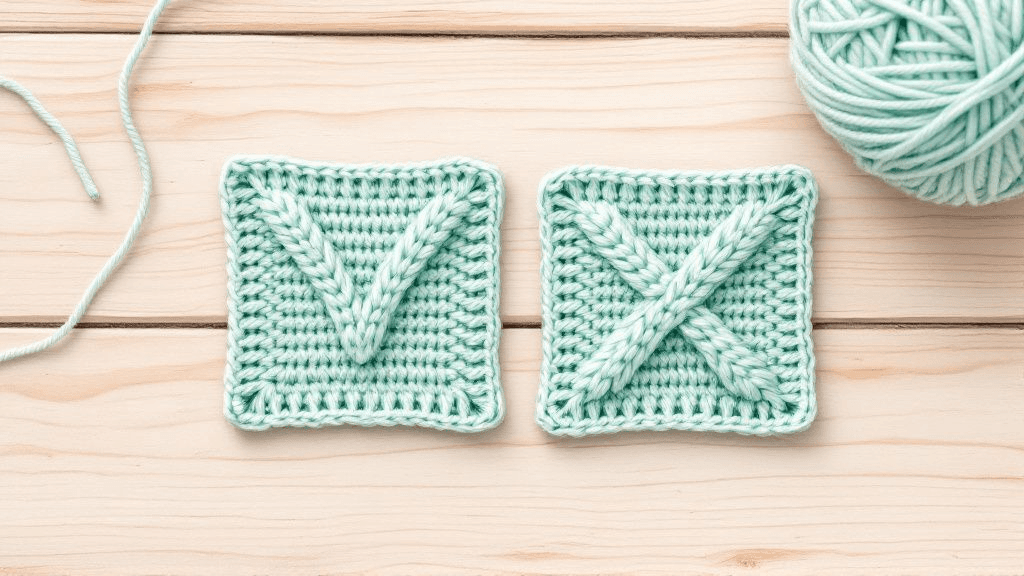
Yarn under vs yarn over is about how you catch the yarn for the first loop of a single crochet. Yarn over wraps the yarn over the hook from back to front and makes a taller, V-shaped stitch. Yarn under catches it from below, making a shorter, X-shaped stitch and a denser fabric that many amigurumi makers prefer.
What "yarn over" means in a standard pattern
In standard crochet instructions, every stitch is built from yarn overs. The abbreviation "yo" means you wrap the yarn over the hook from back to front, then draw it through. When a pattern says "sc", it assumes this method:
- Insert the hook into the stitch.
- Yarn over and pull up a loop (two loops on the hook).
- Yarn over and pull through both loops.
Seen from the right side, each finished stitch looks like a small V sitting on the stitch below. This is how most patterns are written and photographed, and it is a perfectly good way to make amigurumi.
What "yarn under" changes
Yarn under is a variation that only affects step 2. Instead of wrapping the yarn over the hook, you bring the hook under the working yarn and catch it from beneath, so the yarn wraps the opposite way around the hook. You pull up a loop as usual. For step 3, you go back to a normal yarn over and pull through both loops.
Because the first loop is twisted differently, the stitch sits lower and the two legs cross. From the right side it looks like a small X rather than a V. The method is sometimes called "yarn under single crochet" or "X stitch" in tutorials. It is not a different stitch in the sense of a new abbreviation; patterns will still call it sc.
Side-by-side comparison
| Yarn over (standard) | Yarn under | |
|---|---|---|
| Look on the right side | V shapes | X shapes |
| Height of each stitch | Taller | Slightly shorter |
| Yarn used | A little more | A little less |
| Fabric | Firm, with small spaces | Denser, fewer gaps |
| Effect on finished size | Matches most pattern photos | Piece may come out slightly smaller |
| Feel while working | Smooth, the way most people learn | Can feel stiff at first |
Neither method is right or wrong. They simply produce two slightly different fabrics.
Why many toy makers switch to yarn under
The main reason is gaps. Stuffing can show between yarn-over stitches, especially with a hook that is a little large or tension that is loose. The shorter, crossed yarn-under stitch packs more tightly, which hides the filling and makes the surface look smooth and regular. If you keep fighting visible stuffing, our guide to fixing gaps in amigurumi covers this together with hook size, tension and decreases.
Some makers also like how the X stitches line up in neat columns, which gives a tidy surface for embroidered faces.
The trade-offs
Yarn under is not automatically better. Keep these points in mind:
- Size changes. Shorter stitches mean a shorter piece. A toy made with yarn under can end up a little smaller than the pattern says, and limbs may be shorter relative to the body if you switch method between pieces.
- Texture changes. Pattern photos taken with yarn over have V stitches. Your toy will look different, which matters if you are trying to match a photo exactly.
- Reading your stitches. Counting and finding the front and back loops looks different, which can be confusing when you follow photos in a tutorial.
- Hand strain. Some people find the twisted loop harder to pull through, especially with cotton yarn and a small hook.
How to choose
A simple test answers the question for your hands and your yarn. Crochet two small flat circles of six rounds each with the same hook, one with yarn over and one with yarn under. Then compare:
- Hold each one up to the light. Which one hides the gaps better?
- Measure the diameter. How much smaller is the yarn-under circle?
- Think about the feel. Which one was more comfortable to make?
If yarn over gives you dense enough fabric with a slightly smaller hook, there is no reason to change. If you still see gaps, yarn under may be the answer.
The one rule: be consistent
Whatever you choose, use the same method for every piece of a toy. Mixing yarn over on the head and yarn under on the body makes the proportions drift, and the different textures are visible side by side. Decreases and increases work the same way with either method; just keep the first loop consistent.
Yarn under and pattern terminology
Some readers confuse yarn under with UK terminology because the words "single" and "double" mean different things in UK and US patterns. Yarn under is not a UK method; it is simply a way of wrapping the yarn that can be used with any terminology. If a pattern uses unfamiliar stitch names, check whether it follows US or UK terms first. Our US vs UK crochet terms guide shows the conversion.
Does yarn under work for other stitches?
The idea can be applied to half double crochet and taller stitches, but it is mainly used for single crochet, the stitch that makes up most amigurumi. For taller stitches in clothing or decorative parts, follow the method in your pattern to keep the measurements correct.
What happens at increases and decreases
Shaping works the same way with either method. An increase is still two single crochet in one stitch, and a decrease still joins two stitches into one. With yarn under, the two stitches of an increase sit a little closer together, which can make increases less visible on a sphere. The invisible decrease works with either method: you still insert the hook under the two front loops, pull up a loop and finish the stitch, so its look stays close to the stitches around it. Count your stitches at the end of the round just as you would with any method; the totals in the pattern do not change.
Getting used to the motion
The first few rounds of yarn under often feel awkward. Work slowly and watch the hook catch the yarn from below. If the loop is hard to pull through, loosen your grip a little rather than switching to a larger hook, which would undo the point of the method. After a few practice pieces, most people stop noticing the difference in their hands.
Once you have settled on a method, try it on a full project from our amigurumi crochet patterns in PDF.